top of page
Crypto Regulation Desk

A Practical Regulatory Monitoring Checklist for UK and EU Crypto Firms

  • 2 days ago
  • 11 min read

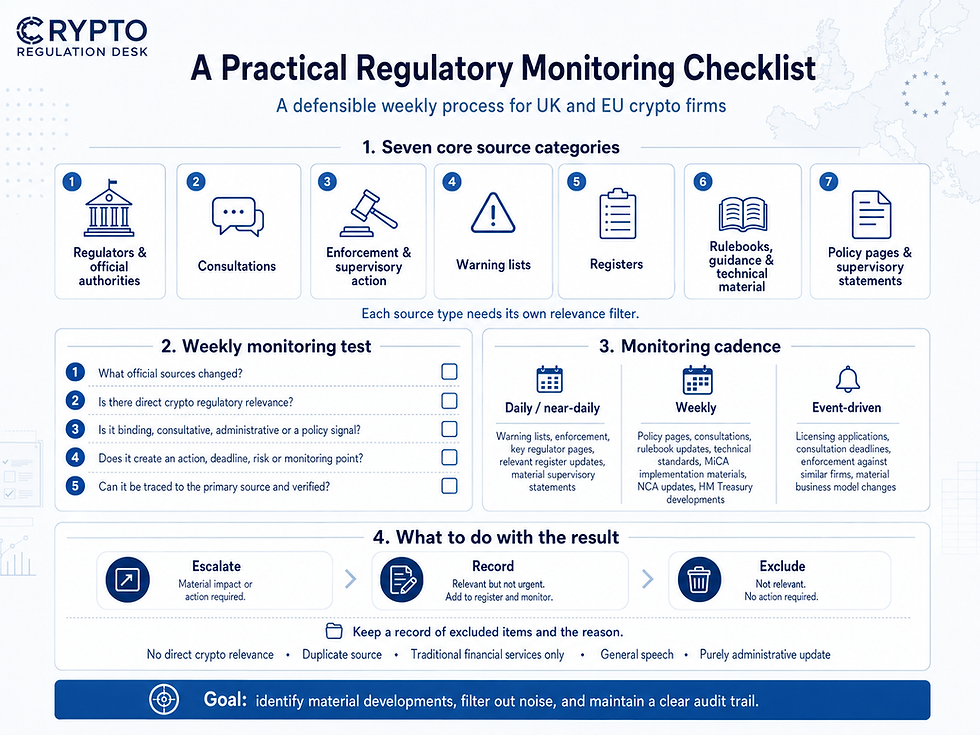
Infographic showing UK and EU crypto regulatory sources being filtered into a concise compliance briefing

Crypto regulatory monitoring is not about collecting as many updates as possible. That is the easy part. The harder part is deciding which updates actually matter.

For UK and EU crypto firms, the volume of regulatory material can quickly become unmanageable. Regulators publish consultations, warnings, enforcement notices, register updates, policy statements, speeches, guidance notes, rulebook changes and technical material. Some of it is directly relevant to crypto firms. Much of it is not.


A useful monitoring process should help compliance, legal and regulatory teams answer five practical questions:


• What official sources have changed?

• Does the change have direct crypto regulatory relevance?

• Is the update binding, consultative, administrative or only a policy signal?

• Does it create an action, deadline, risk or monitoring point?

• Should it be escalated, recorded or excluded?


The goal is not to turn every update into a briefing item. The goal is to identify material developments, filter out noise and keep a clear record of what was reviewed.


Why crypto firms need a structured monitoring process


A crypto firm should not rely only on news alerts, social media, law firm newsletters or informal market commentary. Those sources can be useful, but they are not a substitute for reviewing official regulatory material.


For UK and EU firms, relevant updates may come from several different places, including the FCA, HM Treasury, ESMA, the EBA, national competent authorities, official registers, consultation pages, warning lists and enforcement notices.


The problem is not a lack of information. The problem is that most teams do not have a clear threshold for inclusion.


A weak process asks: “What changed?”


A better process asks: “Did anything change that is directly relevant to crypto regulation, licensing, supervision, enforcement, AML, financial crime, payments, custody, stablecoins, tokenisation, operational resilience, market abuse, consumer protection or regulatory permissions?”


That distinction matters. A general financial regulation update may be interesting, but it does not automatically belong in a crypto regulatory briefing.


What a proper monitoring process should cover


A practical UK and EU crypto regulatory monitoring process should cover the following source categories.


1. Regulators and official authorities


The first priority should be official sources. These are more defensible than market commentary or secondary analysis.


Relevant source types include:


• Financial regulators

• Central banks

• Government departments

• Supervisory authorities

• Legislative bodies

• Official rulebooks

• Official registers

• Official consultation pages

• Official warning lists

• Official enforcement notices


For UK crypto firms, this may include FCA cryptoasset materials, financial promotions updates, warning list changes, enforcement notices, policy statements, consultations and relevant HM Treasury updates.


For EU crypto firms, this may include ESMA MiCA materials, EBA materials, European Commission updates, national competent authority publications, MiCA registers, technical standards, Q&A, consultations and supervisory statements.


The point is not to monitor every page in Europe. That becomes unworkable. The point is to maintain a controlled source list that is relevant to the firm’s jurisdictions, permissions, client base and business model.


2. Consultations


Consultations are important because they often show where the rules are heading before final obligations land.


Crypto firms should monitor consultations that may affect:


• Authorisation or registration

• CASP obligations

• Financial promotions

• AML and financial crime controls

• Custody and safeguarding

• Stablecoins

• Tokenisation

• Payments

• Operational resilience

• Outsourcing

• Governance

• Market abuse

• Client disclosures

• Complaints handling


A consultation is not the same as a binding rule. That distinction should be made clearly in any internal note or external briefing.


The monitoring point is simple: does the consultation create a deadline, a likely future change, or a reason for legal, compliance or policy teams to review the firm’s position?

If not, it may be enough to record that it was reviewed and excluded.


3. Enforcement notices and supervisory action


Enforcement activity gives useful insight into regulatory priorities.


For crypto firms, enforcement and supervisory updates may be relevant where they involve:


• Unauthorised cryptoasset activity

• Misleading financial promotions

• AML or financial crime failings

• Weak governance

• Poor client disclosures

• Breaches of regulatory permissions

• Consumer protection concerns

• Market abuse or trading misconduct

• Sanctions or financial crime risk


An enforcement update should not be included just because it is dramatic. It should be included if it has direct relevance to the firm’s regulatory risk, controls, client activity or business model.


The key question is: “Would a crypto compliance lead genuinely need to know this?”

If the answer is no, it should not be forced into the briefing.


4. Warning lists


Warning list updates can look repetitive, but they can still matter.


They may be relevant to:


• Client onboarding

• Counterparty checks

• Affiliate or introducer arrangements

• Financial promotions review

• Fraud and scam monitoring

• Brand misuse

• Jurisdictional risk reviews


Not every warning list update needs to be escalated. Many will be low priority. But a firm should have a process for deciding when a warning list entry is relevant enough to record or route internally.


For example, a warning involving a similar business model, a known counterparty, a relevant jurisdiction or a commonly used marketing channel may be more significant than a generic warning with no connection to the firm.


5. Registers

Registers matter because they can show authorisation status, market entry, non compliant activity or changes in the regulated population.


Crypto firms may need to monitor registers relating to:


• CASP authorisations

• Transitional arrangements

• White paper notifications

• Non compliant entities

• Cryptoasset service providers

• Payment or e money institutions where relevant

• Firms subject to restrictions, warnings or enforcement


Register changes can be compliance relevant, but they can also be commercially relevant. For example, a new CASP authorisation may affect counterparty due diligence, partnership decisions or competitor monitoring.


The mistake is treating registers as static. In a regulated market, registers are living sources.


6. Rulebooks, guidance and technical material


Rulebooks, guidance and technical standards are where operational obligations often become clearer.


Relevant updates may include:


• Final rules

• Technical standards

• Implementing standards

• Q&A

• Guidance

• Rulebook amendments

• New forms

• Updated reporting requirements

• Changes to application or notification processes

• Revised supervisory expectations


This category needs discipline. A technical update should not be overplayed as a new obligation unless it actually creates or clarifies one.


A good briefing should say clearly whether the item is:

• A binding obligation

• Final guidance

• A consultation

• An administrative update

• A register change

• A warning list update

• An enforcement action

• A non binding policy signal


That classification is important. Compliance teams do not need dramatic language. They need precision.


7. Policy pages and supervisory statements


Policy pages, speeches and supervisory statements can be useful, but they can also create noise.


They should be included only where they provide a clear signal relevant to crypto firms, such as:


• A change in supervisory focus

• A specific concern about cryptoasset activity

• A future rulemaking direction

• A warning about market conduct

• A statement on authorisation expectations

• A clear link to AML, stablecoins, tokenisation, custody, payments or financial promotions


General speeches, internal regulator appointments, broad fintech commentary or traditional financial services updates should usually be excluded unless there is direct crypto relevance.


Do not include an item simply because it could theoretically affect crypto firms one day. If the relevance requires several inferential steps, it is probably too weak.


Daily, weekly and event driven checks


A monitoring process should not treat every source the same way. Some sources justify frequent review. Others only need periodic or event driven review.


Daily or near daily checks


These are most useful for sources where a change could create immediate risk or require prompt awareness.


Examples include:


• Warning lists

• Enforcement notices

• Key regulator crypto pages

• Relevant register updates

• High priority consultation pages near deadlines

• Authorisation or application related updates during an active licensing process

• Material supervisory statements from key regulators


This does not mean every firm must check every source every day. The frequency should reflect the firm’s size, jurisdictions, products and regulatory exposure.


Weekly checks


Weekly checks are better suited to slower moving sources that still matter.


Examples include:


• Policy pages

• Consultation pages

• Rulebook updates

• Technical standards

• Regulator speeches where relevant

• MiCA implementation materials

• National competent authority updates

• HM Treasury or legislative developments


The weekly process should be structured enough to catch meaningful changes, but not so broad that it becomes unreadable.


Event driven checks


Some checks should be triggered by business activity.

Examples include:


• Launching a new product

• Entering a new jurisdiction

• Changing financial promotions

• Onboarding a new partner

• Preparing an authorisation application

• Receiving regulator correspondence

• Updating customer disclosures

• Reviewing custody, staking, lending, payment or stablecoin arrangements

• Preparing a board or committee update


This is where many firms fall down. A source that is not material during routine monitoring may become material when the business changes what it does.


How to decide whether an update is material


A proper monitoring process needs a clear inclusion threshold.

An item should usually be included if it has direct relevance to one or more of the following:

• Crypto regulation

• MiCA

• CASPs

• VASPs

• DPT service providers

• Stablecoins

• Tokenisation

• Crypto custody

• Crypto exchanges

• Crypto brokerage

• Crypto payments

• Cryptoasset financial promotions

• AML

• Sanctions

• Financial crime

• Market abuse

• Consumer protection

• Operational resilience

• Outsourcing

• Cyber risk

• Licensing

• Regulatory permissions

• Regulatory registers

• Warning lists

• Enforcement

• Supervisory expectations

• Regulatory perimeter

• Blockchain based market infrastructure

• Digital securities or tokenised securities, where the source clearly points to that angle


By contrast, a monitoring process should usually exclude items that are only generally relevant to:


• Traditional capital markets

• Banking

• Insurance

• Macroeconomics

• Government securities

• Internal regulator appointments

• Generic fintech innovation

• Open finance

• General policy speeches

• Corporate finance

• IPO rules

• Traditional prospectus rules

• Routine prudential banking updates

• Routine market notices

• Regulator events

• Staff appointments


The test should be strict. If the crypto relevance is indirect, speculative or weak, the item should normally be excluded.


A shorter briefing with three genuinely relevant items is better than a longer briefing padded with seven weak ones.


Priority classification


Included items should be classified by priority.

This prevents all updates being treated as equally important.


High priority


High priority items are updates that may require immediate attention or have clear regulatory significance.


Examples include:


• Binding rule changes

• Final guidance

• Enforcement action

• Licence or register updates

• Warning list updates

• Regulatory deadlines

• Immediate operational compliance impact

• Clear supervisory expectations

• Material changes to a regulatory framework affecting crypto firms


Medium priority


Medium priority items are meaningful but may not require immediate action.


Examples include:


• Consultations

• Official guidance consultations

• Strong policy signals from regulators or public authorities

• Direction of travel clearly connected to crypto, stablecoins, payments, AML, custody, tokenisation or digital asset market infrastructure

• Non binding reports from official or regulator linked sources that are clearly relevant to future crypto policy


Low priority


Low priority should be used sparingly.


It should only apply where the item is genuinely useful to the audience but has limited urgency or no immediate action required.


If an item is weak, exclude it.


Reviewed but excluded items


A serious monitoring process should not only show what was included. It should also keep a record of items reviewed but excluded.


That does not mean every irrelevant update needs a long explanation. But where an item was reviewed and rejected, the reason should be clear.


Useful exclusion reasons include:


• Excluded because it concerns traditional capital markets and does not create a direct crypto regulatory issue.

• Excluded because it is an internal regulator governance update.

• Excluded because it is a routine banking or prudential update.

• Excluded because the crypto relevance is too indirect.

• Excluded because it is a general policy speech without a clear crypto regulatory signal.

• Excluded because it duplicates another official source already reviewed.


This matters because exclusion is part of the control. A good regulatory briefing is not judged by how much it includes. It is judged by whether it includes the right items and rejects the weak ones.


Simple internal record keeping framework


A firm does not need an over engineered system at the start. But it should keep enough information to show that monitoring is being done consistently.


A simple internal record might include:


Record

Purpose

Source reviewed

Shows which regulator page, register, consultation, warning list or update was assessed

Change identified

Captures whether there was a meaningful new item or source change

Relevance assessment

Records why the item was included or excluded

Priority rating

Distinguishes high priority, medium priority and low priority items

Monitoring point

Captures what compliance, legal or regulatory teams should check next

Exclusion reason

Creates a trail for reviewed items that did not meet the materiality threshold


This is enough to create discipline without turning the process into bureaucracy.

The point is not to produce paperwork for its own sake. The point is to make the monitoring process repeatable, reviewable and defensible.


What a useful briefing should contain


A useful crypto regulatory briefing should be concise.

For each included item, it should make clear:


• Region

• Title

• Source

• URL

• Type of update

• What happened

• Why it matters

• Monitoring point


The “what happened” section should be factual.


The “why it matters” section should explain practical relevance without overstating the impact.


The “monitoring point” should tell compliance, legal or regulatory teams what to check, note or review.


A non binding policy paper should not be described as a new compliance obligation. A consultation should not be described as final guidance. An administrative update should not be presented as a major regulatory development.


Precision matters.


Common mistakes to avoid


The most common mistakes in crypto regulatory monitoring are predictable.


• Tracking too many sources without a relevance filter

• Relying on news instead of official sources

• Treating all regulator updates as equally important

• Including weak items to make a briefing look fuller

• Failing to distinguish binding obligations from policy signals

• Failing to record why items were excluded

• Ignoring warning lists and register changes

• Missing consultation deadlines

• Assuming MiCA compliance monitoring ends after authorisation

• Sending long, unfocused updates to senior stakeholders


The worst version of a regulatory briefing is one that looks busy but does not help anyone make a decision.


A Practical Alternative


Not every firm has the time or internal resource to check dozens of official regulatory sources, filter weak updates and turn the relevant items into a concise internal briefing.

Crypto Regulation Desk monitors selected official sources across the UK/EU, Middle East and Singapore, then filters developments for direct relevance to crypto firms. The briefing is designed to identify what changed, why it matters and what compliance, legal or regulatory teams may need to monitor next.


It is not a substitute for legal advice. It is a source-based regulatory monitoring and briefing service intended to reduce the manual burden of reviewing regulator websites and help teams focus on the updates that are more likely to matter.


Practical checklist for UK and EU crypto firms

A crypto firm should be able to answer the following questions.


Source coverage


• Which UK and EU official sources do we monitor?

• Which sources are most relevant to our business model?

• Which jurisdictions matter most for our products and clients?

• Are we monitoring regulators, consultations, enforcement, warning lists, registers, rulebooks, policy pages and supervisory statements?


Review process


• How often are the relevant sources reviewed?

• Which sources require frequent review?

• Which sources are reviewed weekly or periodically?

• Which checks are triggered by business events?

• Who owns the monitoring process internally?


Materiality


• How do we decide whether an update is material?

• Do we distinguish direct crypto relevance from general financial regulation?

• Do we exclude items where crypto relevance is too indirect?

• Do we separate binding obligations from consultations, guidance, administrative updates and policy signals?


Escalation


• Who receives high priority updates?

• What goes to compliance?

• What goes to legal?

• What goes to risk or financial crime?

• What goes to product, operations or marketing?

• What needs senior management or board attention?


Record keeping


• Do we record what was reviewed?

• Do we record why items were included?

• Do we record why items were excluded?

• Do we keep source links and dates?

• Can we show that the process is being followed consistently?


If those questions cannot be answered, the firm probably does not yet have a controlled regulatory monitoring process.


Final thought


Crypto regulatory monitoring should not be an exercise in collecting every possible update. That creates noise and weakens judgement.


A proper process should focus on official sources, direct crypto relevance, materiality, priority classification and clear record keeping.


For UK and EU crypto firms, the objective is simple: identify what changed, decide whether it matters, record the assessment and escalate only what deserves attention. That is what turns regulatory monitoring from a loose information gathering task into a practical compliance control.


bottom of page