
How to Action a Crypto Regulatory Briefing: A Compliance Workflow for Crypto Firms
A crypto regulatory briefing is only useful if it leads to a decision, action or recorded no-action outcome.
Many teams circulate regulatory updates and assume the risk has been handled. It usually has not. Reading a crypto compliance briefing is not the same as actioning it. A regulatory update becomes valuable only when the right person reviews it, assesses the impact, records the decision and drives any necessary follow-up.
Crypto updates can touch licensing, AML, sanctions, financial promotions, custody, Travel Rule controls, stablecoins, outsourcing, governance, reporting, token listings and counterparty due diligence.
A good briefing explains what changed. The firm still needs a disciplined compliance briefing workflow to turn that insight into action.
The better question is not “what changed?”
It is: “what do we now need to do, if anything?”
Key takeaways
Treat every briefing as the start of a controlled internal workflow, not the end of the process.
Every material item needs triage, ownership, impact assessment, a recorded decision and tracked follow-up.
A “no action required” decision should still be recorded where the item is material or potentially relevant. Evidence of judgement matters.
The strongest compliance teams turn crypto regulatory briefings into regulatory change management.
Start by triaging the crypto regulatory briefing
Not every item in a briefing requires the same response.
A crypto regulatory briefing may contain final rules, consultations, guidance, Q&As, material register-related developments, enforcement notices, warning-list updates or policy signals. They should not all be treated in the same way.
Triage should identify which items need attention now, which can be monitored, which are background only and which have no impact on the firm.
Triage category | Meaning | Typical response |
Immediate review | Directly relevant and likely to require action | Assign owner and assess quickly |
Planned review | Relevant but not urgent or not yet final | Assign owner and monitor timeline |
Watchlist | Useful signal but no current action | Log and revisit if needed |
No action | Reviewed and no material impact identified | Record decision and close |
The aim is not to create a committee for every update. The aim is to avoid two common failures: overreacting to everything, and doing nothing because ownership is unclear.
For more on how to judge significance, see our article on what counts as a material regulatory update for a crypto firm.
Classify the regulatory update before deciding what to do
Correct classification prevents overreaction and underreaction when actioning regulatory updates.
A consultation is not a final rule. A Q&A is not the same as legislation. A regulator speech is not the same as formal guidance. A warning-list update is not always an enforcement development. A register change may be routine, or it may affect a counterparty.
This classification matters because it determines the internal response.
Update type | What to ask | Likely response |
Final rule or binding requirement | Does this change our obligations? | Gap analysis, policy review, control update or implementation plan |
Consultation | Should we respond or prepare for likely change? | Assign owner, track deadline and assess future impact |
Guidance or supervisory statement | Does this change expected practice? | Review policies, controls and governance |
Q&A or interpretation | Does this affect how we interpret a requirement? | Review legal or compliance position |
Register change | Does it affect our status or a counterparty? | Update due diligence or internal records |
Enforcement or warning | Does it reveal a relevant supervisory theme? | Compare against internal controls and risk appetite |
Policy signal | Does it indicate future direction? | Monitor and brief senior stakeholders if relevant |
A firm should not build an implementation project around a speculative policy signal. It should also not dismiss a narrow Q&A if that Q&A affects its operating model.
Assign an owner for each material briefing item
Every material item in a crypto regulatory briefing needs a named owner.
That owner is not always the compliance team. Crypto regulatory updates often cut across several functions. A financial promotions update may need marketing and product input. A Travel Rule update may involve compliance, operations and technology. A custody update may involve legal, risk, operations and wallet infrastructure teams.
A useful ownership model separates three roles.
Role | Responsibility |
Review owner | Reads the item and confirms whether it affects the firm |
Business owner | Assesses the operational impact for the relevant area |
Action owner | Completes any agreed follow-up and records closure |
In a small firm, one person may perform all three roles. In a larger firm, they may be separate.
The important point is that ownership must be explicit. Forwarding a crypto compliance briefing to a group inbox is not ownership.
A good actioning process should state who owns the item, what they need to decide and by when.
Assess the firm-specific impact of the regulatory update
The impact assessment is where the crypto regulatory briefing becomes useful.
The firm should ask whether the update affects its own activities, products, customers, jurisdictions, counterparties, controls or governance arrangements.
A practical impact assessment can use a short set of questions:
Does this affect a regulated activity we perform?
Does it affect a product, token, service or customer journey?
Does it affect a jurisdiction where we operate or market?
Does it affect our authorisation, registration or licence position?
Does it affect AML, sanctions, Travel Rule or financial crime controls?
Does it affect custody, safeguarding, outsourcing or operational resilience?
Does it affect client communications, disclosures or financial promotions?
Does it affect a counterparty we rely on?
Does it create a deadline, response window or implementation date?
Does it require legal advice, senior management review or board awareness?
The more direct the link to the firm’s activity, the more likely the update needs action.
Some updates will be important but not urgent. Others will be urgent but narrow. Some will be relevant to the market but not to the firm. The impact assessment should make that distinction clear.
Decide and record the response to the regulatory update
Once the impact is understood, the firm should record a decision.
The decision does not always need to be “take action”. A well-run process may conclude that no action is required. But that conclusion should be recorded, especially for material or potentially relevant items.
Common decisions include:
Decision | When it is appropriate |
No action required | Reviewed and no material impact identified |
Monitor only | Relevant signal, but no immediate action |
Add to watchlist | Future development likely or deadline pending |
Conduct gap analysis | Possible policy, control or process impact |
Update policy or procedure | Current documentation needs to change |
Update systems or controls | Operational or technical implementation needed |
Notify senior management | Material risk, strategic issue or governance relevance |
Seek external advice | Legal interpretation or regulatory uncertainty |
Respond to consultation | Firm may wish to influence or evidence its position |
A short decision record should capture:
briefing item
source and date
priority level
internal owner
affected business area
decision made
reason for the decision
action required, if any
deadline or review date
status
evidence or source link
A high-priority regulatory update should not be closed with a vague “noted”.
Turn regulatory briefing actions into tracked tasks
Where action is needed, the briefing item should move into an action tracker.
This can be a compliance tracker, regulatory change log, risk register, project tool or governance action list. The tool matters less than the discipline.
The action tracker should make clear:
what needs to be done
who owns it
when it is due
what evidence will show completion
whether dependencies exist
whether senior management needs an update
whether the item remains open, blocked or closed
This prevents the most common failure: the briefing is read, the issue is recognised, but no one drives it to completion.
For example, if a regulator publishes a final update affecting crypto financial promotions, the action should not be “compliance to review”. It may be more specific: marketing to identify affected live campaigns, product to review app journeys, legal to confirm approval route, compliance to update sign-off controls, and senior management to receive a short summary.
The clearer the task, the better the follow-through.
Update policies, controls or business processes where needed
Some briefing items should lead to changes in internal documentation or controls.
That may include:
AML or sanctions procedures
Travel Rule processes
financial promotions approval controls
custody or safeguarding procedures
complaint handling processes
outsourcing or third-party risk controls
customer onboarding procedures
product governance documentation
token listing criteria
regulatory reporting calendars
board or committee reporting packs
The actioning process should identify whether the update affects a document, a system, a control, a customer journey, a vendor process or a governance forum.
This is where a crypto compliance briefing becomes operational. A regulatory briefing is not valuable because it says something changed. It is valuable because it helps the firm decide whether its own arrangements still match the current regulatory position.
Archive evidence of the briefing decision
Evidence should be retained in a way that makes sense for the firm.
At minimum, the firm should be able to retrieve the crypto regulatory briefing, the official source, the internal decision and any completed action evidence.
Useful evidence may include:
source link
downloaded regulator document
screenshot or register extract
briefing record
impact assessment
decision note
action tracker entry
updated policy or procedure
committee paper or minutes
legal advice summary
implementation evidence
Evidence should be proportionate. A low-priority watchlist item does not need the same evidence pack as a high-priority final rule.
But if a material item has been reviewed, the firm should be able to show what was decided and why.
Monitor follow-up until the regulatory item is closed
Some regulatory updates do not end with the first briefing.
A consultation may later become a final rule. A policy statement may be followed by implementation guidance. A warning theme may develop into enforcement action. A Q&A may be followed by further clarification. A register update may lead to a change in counterparty status.
The compliance briefing workflow should therefore include follow-up monitoring.
This is particularly important where the item has a deadline, a consultation response date, an implementation period or a known dependency.
A good follow-up record should show:
what the firm is waiting for
who owns the follow-up
when it should be checked again
what would trigger escalation
whether the item has been closed or remains open
This avoids losing sight of items that are relevant but not yet final.
Close the loop with senior management where the update is material
Some briefing items should not stay at compliance-team level.
Where an update creates material regulatory risk, requires budget, affects market access, changes the firm’s risk appetite, or needs cross-functional delivery, it should be escalated through the firm’s governance process.
That may mean a short update to senior management, a risk committee, a board committee or another relevant governance forum.
This is particularly important where the action requires resources that compliance does not control. For example, a Travel Rule update may require system changes. A financial promotions update may require changes to app journeys or marketing controls. A custody update may require operational, technology or vendor review.
The monitoring workflow should therefore identify when an item needs governance reporting, not just compliance review.
A useful senior management note should be short and decision-focused:
“This update may require changes to our onboarding and transaction monitoring controls. Compliance recommends a gap analysis by [date], with input from Operations and Technology. Any required system changes should be reviewed for budget and delivery impact.”
This helps turn regulatory monitoring into active risk management.
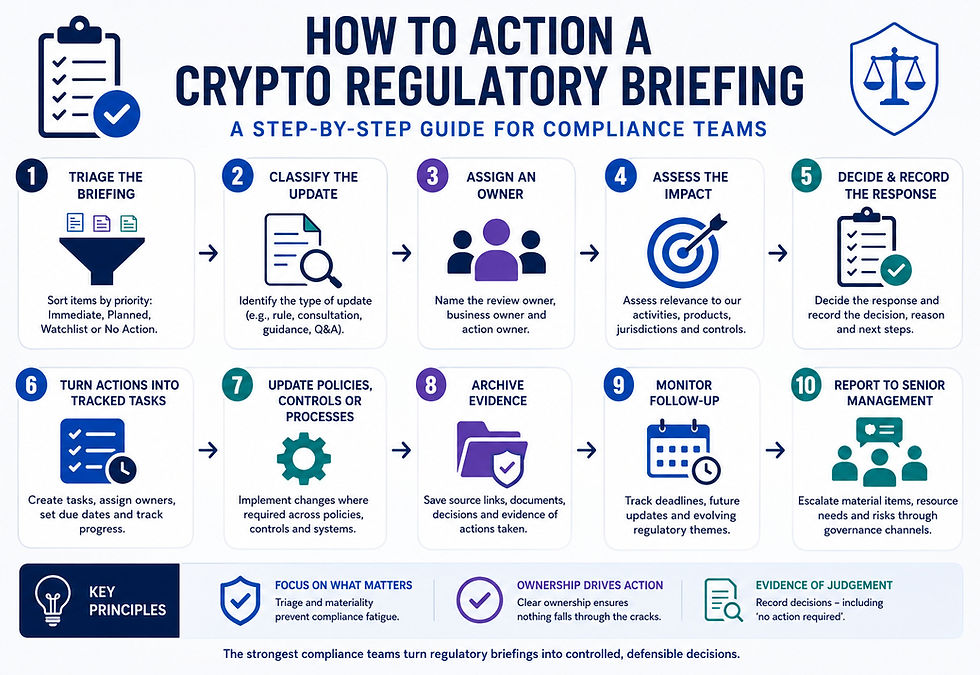
Use a simple compliance briefing workflow
The process does not need to be complicated.
A practical compliance briefing workflow could look like this:
Step | Action | Output |
1 | Receive briefing | Briefing logged |
2 | Triage items | Priority assigned |
3 | Classify update type | Legal status and relevance understood |
4 | Assign owner | Named reviewer or team |
5 | Assess impact | Firm-specific relevance recorded |
6 | Decide response | Decision logged |
7 | Track action | Owner, deadline and status recorded |
8 | Archive evidence | Source and decision retained |
9 | Monitor follow-up | Open items reviewed until closed |
10 | Report material items | Senior management or committee updated where needed |
This workflow is simple enough for a small firm but structured enough for a larger compliance team.
The aim is not to slow the business down. It is to make regulatory change management controlled and traceable.
What a good internal note should say after a crypto regulatory briefing
A weak internal note says:
“Please see attached regulatory update.”
A better internal note says:
“The attached briefing includes a high-priority FCA update on crypto financial promotions. Marketing, product and compliance should review live UK-facing website content, app journeys and approval controls. Please confirm by Friday whether any changes are required or whether current controls remain sufficient.”
The second note is better because it identifies the issue, the affected teams, the review required and the decision needed.
That is what actioning a briefing looks like.
For more on the structure of a useful briefing, see our article on what a crypto compliance briefings should include and what they should ignore.
Common mistakes when actioning crypto regulatory briefings
Several mistakes appear regularly.
The first is forwarding the briefing without assigning ownership. Information has moved, but responsibility has not.
The second is treating every item as urgent. That creates fatigue and makes it harder to identify genuinely important updates.
The third is treating every item as background. That creates the opposite problem: material updates are noted but not acted on.
The fourth is failing to distinguish between final rules, consultations, guidance, Q&As, enforcement signals and register changes.
The fifth is recording actions but not decisions. A “no action required” decision should still be recorded for material items.
The sixth is failing to involve the right business teams. Many regulatory updates affect product, operations, technology, marketing, onboarding or senior management, not only compliance.
The seventh is not monitoring follow-up. Consultations, implementation deadlines and supervisory themes can develop after the first crypto regulatory briefing.
The eighth is failing to escalate resource issues. Some regulatory actions require budget, systems work or senior prioritisation. If compliance cannot deliver the action alone, the issue needs governance visibility.
Final point
A crypto regulatory briefing is not the end of the process. It is the start of the internal compliance workflow.
The briefing should identify the relevant official update, explain why it matters and point to the likely monitoring action. The firm then needs to triage it, assign ownership, assess impact, record the decision, track any follow-up and retain evidence.
Where the issue is material, resource-heavy or cross-functional, it should also reach the right governance forum.
That is how a crypto compliance briefing becomes useful.
The strongest compliance teams do not simply circulate regulatory updates. They turn crypto regulatory briefings into controlled decisions, tracked actions and regulatory change management.
Crypto Regulation Desk monitors selected official regulatory sources across the UK/EU, Singapore and the Middle East, filters them for material crypto regulatory relevance, and produces concise, source-linked briefings for compliance, legal, regulatory and risk teams.
To test a source-based monitoring process without building it manually, request a 14-day trial of Crypto Regulation Desk.


