MAS DPT Regulatory Updates: What Digital Payment Token Firms Should Watch
Updated: May 7
DPT monitoring is not just licensing.
For a digital payment token firm in Singapore, getting licensed or preparing a licence application is only one part of the regulatory workload. The harder operational challenge is keeping track of what changes after the licensing position is understood.
MAS updates can affect AML controls, consumer communications, risk disclosures, technology risk, outsourcing, safeguarding, incident handling, senior management oversight and the way a firm describes its services to the market. Some updates may impose legal requirements. Some set out supervisory expectations. Some are consultation signals. Some are administrative. Treating all of them the same is a weak monitoring process.
This article is not legal advice. It is a practical guide to what DPT firms should monitor, how to think about MAS updates, and what should trigger internal review.
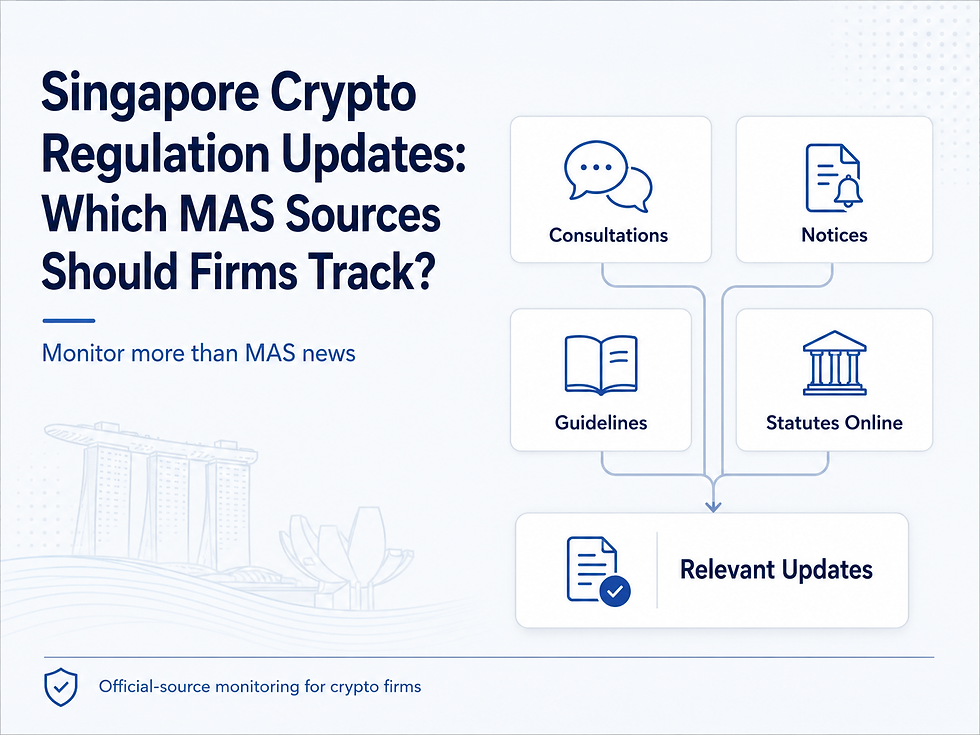
The full list of MAS sources worth tracking is covered in Singapore Crypto Regulation Updates: Which MAS Sources Should Firms Track? This article focuses on the operational relevance for licensed or applicant DPT firms.
Why DPT firms need a separate monitoring process
A generic crypto news feed will not give a DPT firm enough control.
The important MAS update may not arrive as a headline grabbing press release. It may appear as a notice, guideline, consultation response, amendment to a payment services page, new regulatory form, change to an AML notice, update to consumer protection expectations, or enforcement announcement.
For a DPT firm, the question is not simply “has MAS said anything about crypto?”
The better question is:
“Has anything changed that could affect our licence position, customer communications, AML framework, technology risk controls, outsourcing arrangements, product governance or senior management oversight?”
That is why DPT firms need a separate monitoring process. The sources are narrower, the operational impact is more specific, and the internal owners are not always the same.
MAS DPT updates are not all the same
A common mistake is to treat every MAS update as if it has the same legal status.
MAS materials can appear in different forms, including legislation, regulations, notices, guidelines, circulars, consultation papers, consultation responses, speeches and enforcement announcements. These should not be treated as interchangeable.
A notice may impose legally binding requirements where it applies to the firm and activity in question. Guidelines usually set out MAS’ expectations, standards or guidance on how firms should approach particular issues. Consultation papers are proposals, not final rules. Enforcement announcements are not new rules, but they can show supervisory focus and failure patterns.
That distinction matters. A DPT firm should know whether it is looking at a binding requirement, supervisory expectation, future proposal, operational clarification or read across risk.
MAS item type | Why it matters | How a DPT firm should treat it |
Act or regulations | Core legal framework | Legal and compliance review |
MAS notice | May impose legally binding requirements where applicable | High priority compliance review |
MAS guideline | Supervisory expectations, standards or guidance | Compliance, risk and governance review |
MAS circular | Clarification, reporting guidance or operational instruction | Review depending on subject matter |
Consultation paper | Possible future regulatory change | Track, assess and decide whether to respond |
Consultation response | Strong signal of final or future policy direction | Review against product and control roadmap |
Enforcement announcement | Shows supervisory focus and failure patterns | Review for read across risk |
The point is not to downgrade guidelines or circulars. The point is to classify them properly. A firm that cannot distinguish legal status is unlikely to have a strong monitoring process.
What DPT firms should watch
1. AML and CFT updates
AML and CFT remain one of the highest priority monitoring areas for DPT firms.
MAS Notice PSN02 and the related guidelines are central sources for DPT firms. MAS describes PSN02 as the notice containing AML/CFT requirements for digital payment token service providers, while the related guidelines provide guidance on those requirements.
DPT firms should monitor for changes affecting customer due diligence, enhanced due diligence, transaction monitoring, screening, suspicious transaction reporting, travel rule controls, sanctions, governance and record keeping.
The internal review point is simple: any MAS update touching AML/CFT should usually be routed to compliance, financial crime, legal and relevant operations teams. It should not sit only as a general regulatory update.
2. Consumer protection and retail conduct
MAS has issued guidelines on consumer protection measures for DPT service providers. MAS describes PS G03 as setting out expectations on measures DPT service providers should have in place to address consumer protection risks.
Updates in this area can affect onboarding journeys, risk disclosures, product access, customer warnings, incentives, custody communication and treatment of retail users.
This is an area where regulatory monitoring needs to connect with product and customer operations. A consumer protection update may not only be a legal issue. It may affect how the product is presented, how users are warned about risk, and how customer journeys are designed.
3. Public promotion and consumer communications
MAS PS G02 sets out MAS’ expectations on the provision and promotion of DPT services to the general public in Singapore. MAS describes the guideline as setting out expectations that DPT service providers should not promote their DPT services to the general public in Singapore.
DPT firms should watch for changes affecting website wording, social media content, referral campaigns, public advertising, app store descriptions, customer explainers and retail focused campaigns.
The compliance risk here is practical. Marketing and product teams can move quickly. If MAS updates its expectations around promotion or consumer communications, the firm needs a process for getting that update to the people approving external content.
4. Technology risk and cyber resilience
DPT firms are technology businesses as much as financial services businesses.
MAS technology risk materials can be relevant where a DPT firm relies on custody infrastructure, wallet systems, cloud providers, APIs, trading systems, blockchain analytics tools, customer portals or outsourced technology vendors.
A DPT monitoring process should watch for updates affecting cyber security governance, access controls, incident response, system availability, change management, vulnerability management, cloud architecture, third party technology risk and operational resilience.
The owner is unlikely to be legal alone. Technology risk updates may need review by risk, information security, engineering leadership, compliance and senior management.
5. Outsourcing and third party risk
Most DPT firms rely heavily on third parties.
That may include cloud providers, custody technology vendors, wallet infrastructure providers, blockchain analytics tools, customer onboarding providers, sanctions screening vendors, payment partners, market data providers and operational support providers.
DPT firms should monitor MAS materials that may affect third party risk, material outsourcing, vendor due diligence, audit and access rights, sub outsourcing, exit planning, business continuity, incident notification and operational concentration risk.
A firm can have a strong licence file and still carry weak third party risk. That is why outsourcing and operational dependency monitoring should not be treated as a back office issue.
6. Licensing and application related updates
Applicant firms need to monitor licensing materials closely.
A change to a form, application process, disclosure requirement, regulatory FAQ or MAS clarification may affect how a firm prepares or updates its application. Licensed firms should also watch for changes that could affect variations, new services, cross border activity, group structure, controllers, senior appointments or business model changes.
The right question is not “does this definitely apply to us?” The safer and more useful question is “does this require legal, licensing or compliance review given our current or planned activity?”
That keeps the monitoring process practical without overstepping into legal advice.
7. Enforcement and supervisory signals
Enforcement updates are useful even when they are not about your firm.
They can show where MAS is focusing attention, what types of failures are being publicised, and what control weaknesses may create supervisory concern.
DPT firms should review enforcement announcements for read across risk. The review should ask whether the item involves a similar business model, similar customer activity, similar controls, similar technology dependencies or similar conduct risk.
The aim is not to overreact to every enforcement item. The aim is to identify whether a short internal review is needed.
8. Stablecoin related updates
Stablecoin monitoring deserves separate attention.
Stablecoin related requirements are covered in more detail in the stablecoin regulatory updates article.
For DPT firms, stablecoin developments may matter even if the firm is not an issuer. Updates can affect listing decisions, custody, payments, redemption arrangements, customer disclosures, settlement models, counterparty risk and product governance.
The mistake is to treat stablecoins as a separate issue that only affects issuers. In practice, stablecoin regulatory developments may also affect exchanges, custodians, brokers, payment firms and institutional digital asset platforms.
What should trigger internal review?
Not every Singapore DPT regulatory update needs a full internal memo. That would create noise.
However, an update is more likely to deserve internal review where it affects:
Licensing or application status
DPT service provision
AML/CFT controls
Customer communications
Consumer protection
Public promotion
Stablecoin activity
Technology risk
Outsourcing or third party dependency
Regulatory reporting or notifications
Enforcement risk
Cross border activity
Senior management oversight
A simple escalation model is usually enough.
Update type | Likely internal owner |
AML/CFT update | Compliance, MLRO, financial crime |
Consumer protection update | Compliance, product, customer operations |
Public promotion update | Compliance, marketing, legal |
Technology risk update | Risk, CISO, CTO, compliance |
Outsourcing update | Risk, procurement, legal, operations |
Licensing update | Legal, compliance, senior management |
Enforcement item | Compliance, risk, senior management |
Stablecoin update | Legal, product, treasury, compliance |
This does not mean every update is material. It means the firm has a defensible process for deciding whether it is material.
DPT monitoring checklist
A practical DPT monitoring process should answer these questions:
Have we checked the relevant MAS and official Singapore sources, not just crypto news?
Have we identified whether the update is a notice, guideline, circular, consultation, response paper, form change, enforcement item or general announcement?
Have we distinguished binding requirements from guidance, expectations and policy signals?
Have we recorded why the update is relevant or not relevant to our business?
Have we assigned the update to the correct internal owner?
Have we checked whether the update affects current operations, planned products or only future strategy?
Have we considered whether it affects customer communications or public promotion?
Have we considered AML/CFT and sanctions impact?
Have we considered technology risk and outsourcing impact?
Have we kept a record of excluded items?
Have we linked back to the official source?
The final point matters. A good DPT regulatory update process should be source backed. If the update cannot be verified against an official source, it should not be treated as a reliable compliance input.
The summary below highlights what DPT firms should watch for on an ongoing basis.
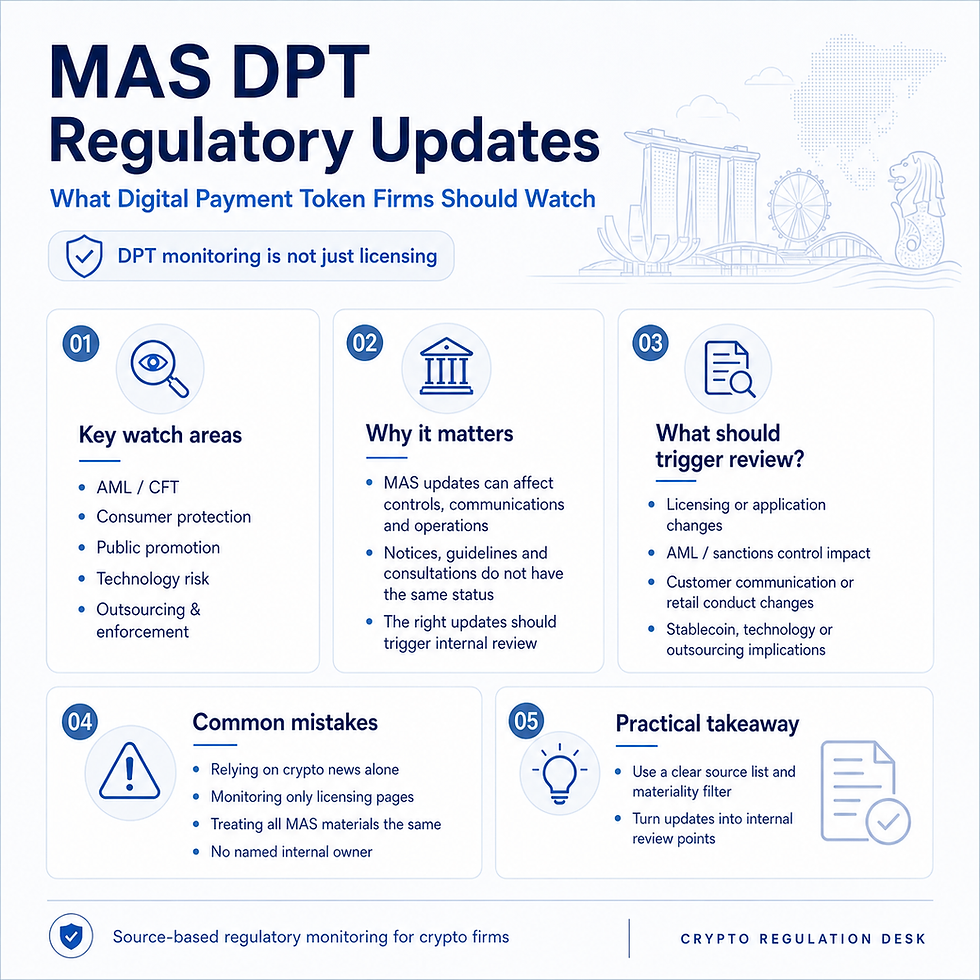
This focused approach prevents monitoring overload while catching what actually matters.
Common mistakes in DPT regulatory monitoring
The first mistake is relying on crypto news instead of official sources. News is useful for awareness, but it is not the regulatory position.
The second mistake is monitoring only licensing pages. A licensed or applicant DPT firm also needs to track AML/CFT, conduct, technology risk, outsourcing, consumer protection, enforcement and stablecoin developments.
The third mistake is treating all MAS materials as legally identical. Notices, guidelines, circulars and consultation papers need different handling.
The fourth mistake is failing to assign clear internal owners. A consumer protection update may need product review. A technology risk update may need engineering input. An AML update may need financial crime review.
The fifth mistake is keeping no record of excluded items. If a firm reviews a MAS update and decides it is not relevant, that decision should be capable of being explained later.
A practical alternative
Monitoring Singapore sources properly takes time and discipline. Many teams reduce this burden with a crypto compliance monitoring service.
Crypto Regulation Desk monitors selected official regulatory and public authority sources across the UK/EU, Middle East and Singapore, then filters developments for direct relevance to crypto firms.
For DPT firms, the aim is to identify MAS, SSO and related official source changes that may matter to digital payment token services and related activities. The service is not a law firm and does not provide legal advice. It is a source based regulatory monitoring and briefing service designed to reduce the manual burden of reviewing regulator websites.
How to get started
Crypto Regulation Desk is built for teams that do not want to manually check MAS, SSO and other official source pages every week.
You can start with a 14-day trial, or subscribe if you have reviewed the sample and are ready to proceed. All plans are monthly rolling subscriptions, with no long term contract and no lock in. You can cancel at any time.
DPT monitoring is not just licensing. The firms that manage it well are those with a clear source list, strong materiality filter, named internal owners and a disciplined process for turning regulatory updates into internal review points.